Purpose
Return value
Syntax
=COSH(number)
- number - The hyperbolic angle.
Using the COSH function
The Excel COSH function returns the hyperbolic cosine of a number, which represents a hyperbolic angle . Given the input of 1, the function returns the value 1.543080635.
=COSH(1) // returns 1.543080635
Explanation
The hyperbolic cosine function returns the horizontal component of the point on the right branch (x ≥ 1) of the unit hyperbola corresponding to the hyperbolic angle given as input.
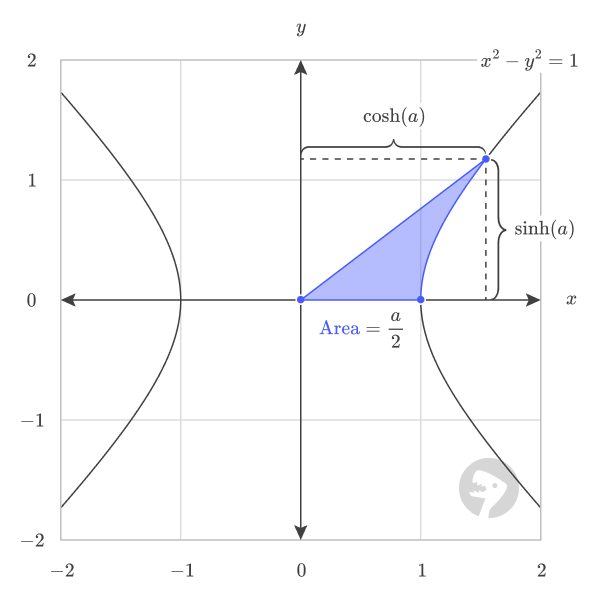
Together with the hyperbolic sine function , the functions parameterize the right branch of the unit hyperbola given by the equation x² - y² = 1. In plain language, this means that the two functions trace out the shape of the right branch of the unit hyperbola. Given a hyperbolic angle corresponding to a point on the hyperbola’s curve, COSH returns the horizontal component of the point, while SINH returns the vertical component of the point.
For example, given the hyperbolic angle -1, hyperbolic cosine returns the x-component 1.543080635, and hyperbolic sine returns the y-component -1.175201194.

Here is a table that shows some points on the unit hyperbola formed by COSH and SINH.
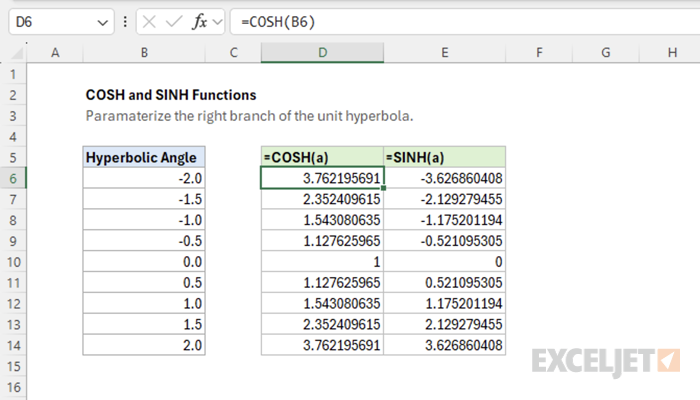
As the value of the hyperbolic angle gets larger, the horizontal component diverges to infinity. This is different from the circular cosine function , which is periodic and repeats values.

Images courtesy of wumbo.net .
Purpose
Return value
Syntax
=COT(number)
- number - The angle provided in radians.
Using the COT function
The Excel COT function returns the cotangent of an angle provided in radians. In geometric terms, the cotangent of an angle returns the ratio of the length of the adjacent side over the length of the opposite side of the corresponding right triangle. For example, the cotangent of PI()/6 (30°) returns the ratio 1.732.
=COT(PI()/6) // Returns 1.732
Using Degrees
To supply an angle to COT in degrees, multiply the angle by PI()/180 or use the RADIANS function to convert to radians. For example, to get the COT of 60 degrees, you can use either formula below:
=COT(60*PI()/180)
=COT(RADIANS(60))
Explanation
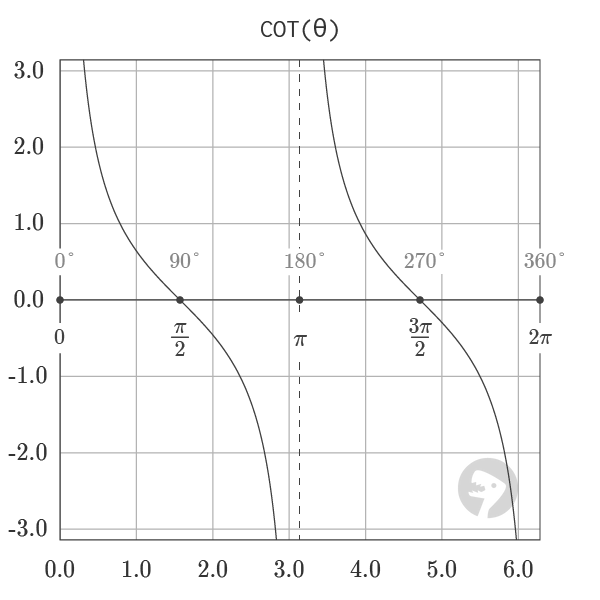
The graph of COT, shown above, visualizes the output of the function for angles from 0 to a full rotation. The function has vertical asymptotes at the points 0, π, and 2π where the output of the function diverges to infinity. The COT function is the reciprocal of TAN and can be equivalently defined in the formula below:
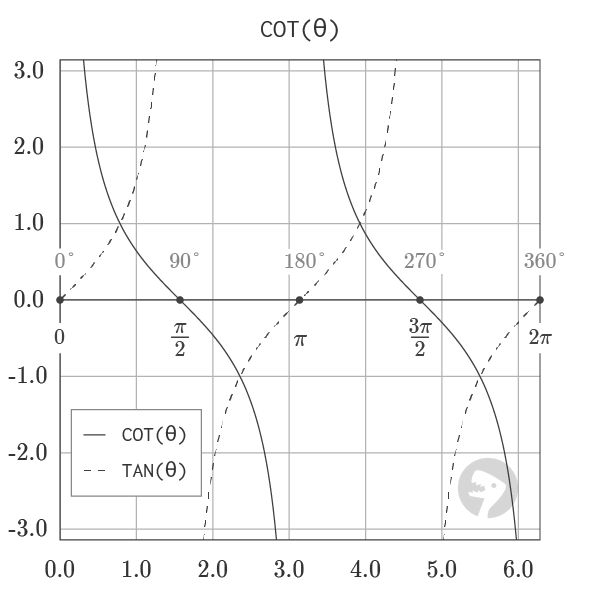
=COT(angle)=1/TAN(angle)
The reciprocal relationship between COT and TAN is visualized by the graph shown below of both of the functions plotted together.
Graphs courtesy of wumbo.net .
