Purpose
Return value
Syntax
=IMSUB(inumber1,inumber2)
- inumber1 - Complex number 1.
- inumber2 - Complex number 2.
Using the IMSUB function
The IMSUB function returns the difference between two complex numbers. For example:
=IMSUB("4+3i","1+2i") // returns "3+i"
Excel handles complex numbers as strings formatted like “x+yi” or “x+yj”. Use the COMPLEX function to get the string representing a complex number.
Explanation
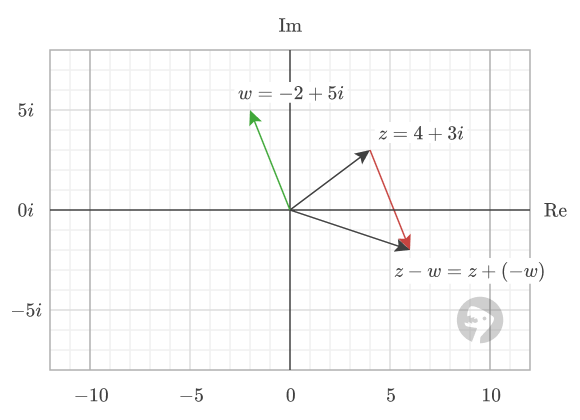
The result of the IMSUB function can be visualized by adding the opposite of the second vector tip-to-tail with the first. For example, the result of the subtraction below
=IMSUB("4+3i","-2+5i") // returns "6-2i"
is visualized like this:
Purpose
Return value
Syntax
=IMSUM(inumber1,[inumber2],...)
- inumber1 - Complex number 1.
- inumber2 - [optional] Complex number 2.
Using the IMSUM function
The Excel IMSUM function returns the sum of two or more complex numbers. For example:
=IMSUM("4+3i","2-5i") // returns "6-2i"
Excel handles complex numbers as strings formatted like “x+yi” or “x+yj”. Use the COMPLEX function to get the string representing a complex number.
Examples
The IMSUM function takes in two or more arguments in the form inumber1 , inumber2 , inumber3, and so on. Arguments can be hard-coded values, cell references, or a range. Use the IMSUM function in a range like this:
=IMSUM(B6:B10) // sum complex numbers in B6:B10
If Excel encounters values not recognized as complex numbers, a #NUM! Error is thrown.
=IMSUM("4+3i", "invalid input") // throws #NUM! error
Explanation
The sum of two complex numbers is visualized by arranging the arrows tip-to-tail and drawing an arrow from the origin to the tip of the second number. For example, the sum of “4+3i” and “2-5i” is visualized below, where the arrow “6-2i” is the sum of the complex numbers.
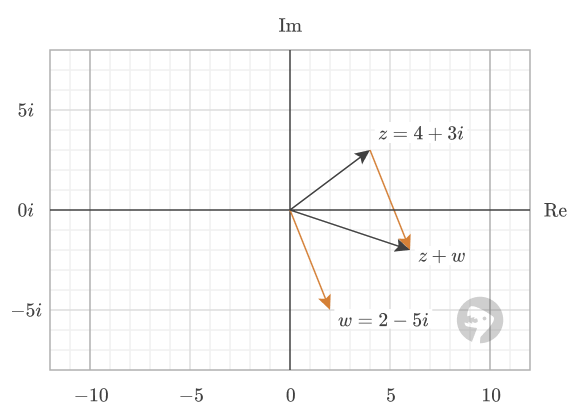
Image courtesy of wumbo.net .
